Archive for the ‘Articles’ Category

What Do Baby Chicks Eat? Chick Starter Feed Is Key for Lifetime Success

Thursday, January 19th, 2023

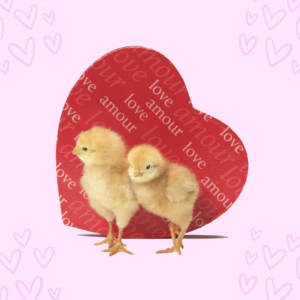
What Do Baby Chicks Eat?What Do Baby Chicks Eat? Baby chicks grow quickly, doubling their hatch weight in the first week and growing up to seven times their hatch weight in the first month. To support this early growth, baby chicks should eat a complete starter-grower feed which contains the 38 unique nutrients they need to start strong and stay strong. A starter-grower feed with the Chick Strong® System helps raise strong chicks that grow into happy, healthy hens.

An apple a day keeps the doctor away. No dessert before dinner. Eat your vegetables! Do you remember hearing these phrases at the dining room table while growing up? Although you may have hated brussels sprouts, these wise words had the best intentions: Eat healthy, so you can grow strong.

We give advice with the same intent to backyard chicken raisers.

Lifetime success begins on day one. It all starts with chick nutrition and care. Baby chicks need 38 unique nutrients to grow into happy, healthy hens. Each of these nutrients – and the proper balance of them – plays a role in growth, performance and flock happiness.

Raising baby chicks into happy, healthy hens starts on day one:

Your mother’s advice to eat more vegetables wasn’t just something to roll your eyes at. A balanced diet supports life-long health and well-being.

Industry research shows the long-term impact of early nutrition on lifetime health and performance.1 The same holds true for backyard chickens. Feeding chicks for a strong start can better equip them for a lifetime of success.2

Just like people and other animals, chicks need a strong start to grow into happy, healthy adults. Many people begin raising backyard chickens for farm fresh eggs, but before the first egg arrives, early chick nutrition is the foundation.

Early nutrition develops the digestive tract and builds a healthy immune system, ultimately improving chick growth.Providing chicks a complete starter-grower feed is key.

Chicks grow quickly, doubling their hatch weight in the first week and growing up to seven times their hatch weight in the first month. This early growth requires the correct balance of nutrients.

What to feed baby chicks:

Start your chicks strong by feeding a complete starter-grower feed from day 1 until the first egg arrives around week 18.

Each of these starter-grower feeds includes all 38 nutrients baby birds need to start strong and grow at the proper pace. Some nutrients directly impact bone, skeletal and chick growth while others work in tandem to support overall bird health and appearance.

Nutrients in Purina® complete starter-grower feeds include:

  • 18% protein and 1.25% calcium for bone and body growth
  • Prebiotics and probiotics for immune and digestive health
  • Amino acids for muscle and feather development
  • Marigold extract for brightly colored beaks, feet and legs and overall appearance
  • Phosphorous and trace minerals for bone strength
  • Vitamins A, D, E, K and B for overall health and growth
  • Continue feeding the same starter-grower feed from day 1 to week 18. We recommend waiting to introduce treats or scratch to the diet until week 18. If you are feeding a complete starter-grower feed, your chicks do not need grit. If you start chicks on a medicated starter-grower feed, keep feeding that same medicated feed until their first egg.

Most layer chick breeds will lay their first egg around week 18. At that time, transition to a complete Purina® layer feed to help hens lay strong.

In conclusion, visit Kissimmee Valley Feed for all your backyard flock’s needs! Check out our supplies here.

Article Source: Patrick Biggs for Purina Mills
12 Calving Season Essentials

Wednesday, January 4th, 2023

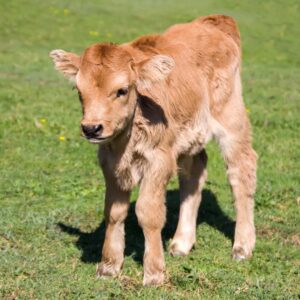
12 Calving Season Essentials12 Calving Season Essentials:

Start planning early for a seamless calving season.

Now’s the time to plan for spring calving and/or fall calving. Make sure you have a reliable team, including a trusted veterinarian on speed-dial.

Prepare a dedicated calving area with ample space that’s clean, dry and protected from the elements. And, stock up on these spring calving and fall calving season essentials.

1. NON-IRRITANT ANTISEPTIC AND EXTRA BEDDING

Protect newborn calves during calving season from disease-causing pathogens with a clean, dry environment.

2. CLEAN TOWELS

Calving season can be a messy business, be ready to clean it up.

3. IODINE, VACCINATIONS AND ANTIBIOTICS

Work with your vet to create or refine a spring calving or fall calving protocol for your operation.

4. OBSTETRICAL CHAINS, TWO HANDLES AND MECHANICAL CALF PULLERS

Keep these supplies on hand in case you need to pull a calf.

5. A CLEAN SURFACE FOR USED EQUIPMENT

Avoid having to pick up tools or equipment from soiled bedding.

6. DISPOSABLE OBSTETRICAL SLEEVES

Use a new pair every time.

7. LUBRICANT

Nothing fancy required. Get the job done with non-detergent soap and warm water.

8. A CALVING BOOK FOR RECORD-KEEPING

There’s no such thing as too many records, be ready on day one.

9. EAR TAGS AND A TAGGER

Add a spare tagger for good measure.

10. A SLED WITH ROPES AND A HEATER

Protect calves from the elements during extra cold winter weather.

11. COLOSTRUM REPLACER, ELECTROLYTES AND AN ESOPHAGEAL FEEDER

Ensure calves get the nutrition they need if the weather’s especially harsh, or if they can’t nurse their dam.

12. EXTRA COVERALLS AND BOOTS

Keep extra hats and gloves handy in case there’s unexpected cold weather.

Just like a well-planned calving season can support calf performance down the road, a balanced cow nutrition program can support breeding performance for years to come.

Don’t put cow nutrition on the back burner during calving season. Providing cows with the proper mineral now can pay dividends next year.

Feed a high-quality mineral year-round to build up mineral stores and prepare cows to breed back quickly. Consider a source with Availa 4® organic trace minerals, like Purina® Wind and Rain® Mineral to support cow nutrition. Visit a Kissimmee Valley Feed for all your calving needs.

New Year Resolutions for Pets

Friday, December 30th, 2022

siamese cat by new year signNew Year Resolutions for Pets: Tips for enhancing animals’ lives and our own. That’s right, pets can have New Year’s Resolutions too!
With the New Year here, it’s time to take stock and make improvements in our lives and our pets’ lives. Here are some New Year Resolutions for Pets ideas and tips to hopefully enhance the health and add some fun to your pets’ lives.

Pets can suffer from overeating and lack of exercise just like humans. But there are more things to consider than diet and exercise when it comes to being a good example for our pets. Here are a few tips to help your pets be happier and healthier in 2025.

8 Tips:

    1. Exercise

      Firstly, regular exercise has the obvious health benefits, but it also is a great time to bond with our pets. A simple daily walk helps a dog learn proper manners. In addition, it provides some good quality time, and does wonders for the human counterpart, too! Keeping pets at the proper body weight reduces the risk of heart and joint problems, diabetes, and a host of other poor health conditions.

    2. Health Check Up

      Secondly, regular visit to your veterinarian is the best way to stay ahead of potential problems. Annual examinations of teeth, heart/lungs, and body condition overall will be less costly than waiting for a problem to develop and your pet suffering needlessly from complications of preventable problems. Having a good “baseline” of information about your pet also gives the veterinarian something to compare against and determine exactly what is wrong when something isn’t quite right with your pet.

    3. Good Nutrition

      Like humans, pets who eat poor quality food just do not have the health reserves that those that a good balanced diet. Poor skin, hair coat, muscle tone, and obesity problems can be a result of a poor diet. Also, pets are not humans — a diet rich in table scraps is not a healthy one, and can lead to problems such as obesity and pancreatitis.

    4. Good Grooming

      No one wants to be around a stinky pet. Regular grooming for example, bathing, toe nail clips, brushing teeth and hair coat, parasite control. As a result, it not only makes the pet more pleasing to be around, it is much healthier for the pet! For skin and coat problems that don’t resolve with regular grooming, please see your veterinarian. Above all, there may be an underlying medical condition affecting the skin, coat, or toenails.

    5. Safety

      Keeping pets safe is something most pet owners take for granted. However, take a moment to assess the toxic chemicals used in your house and yard. Are they necessary? Are all safety precautions followed? Where are household chemicals stored? Can your pet access these items? If toxins such as rodent poisons are used, can your pet access the rodents? Think too about enclosures for pets — is the fencing secure? Can your pet get caught or hooked up on the fence, a tree, etc. and choke or be stuck out in the weather when you are away?

    6. Information

      Being informed is the best way to keep track of our pet’s health and well-being. If possible, keep a medical log of your pet’s vet visits, medications, special needs, etc. to help keep track of your pet’s medical history. Knowing what is normal and not normal for your particular pet will assist your vet figure out what is wrong in the case of illness. For example, the Internet is a wealth of information. However, caution is advised. Especially when seeking out a diagnosis or medical assistance via the web. Just as in real life, there is good information and bad information out there. The only way to get an answer/diagnosis is through a thorough physical examination. In addition, a review of medical history, and possible lab work performed by your veterinarian.

    7. Love and Attention

      This is probably obvious, but too many pets are left outside in all kinds of weather, with very little human contact. Same goes for inside pets. For example, those who are largely ignored for lack of time and busy human schedules. Most importantly, take the time to focus on your pets and create/nourish that human-animal bond!

    8. Maintenance

      This refers to the more “unpleasant” aspects of pet care. For example, the litter box scooping, yard clean up, cage cleaning, and fish tank maintenance. A clean environment for our pets is a healthy one! Poor sanitation can lead to behavior problems (i.e. litter box avoidance) and health problems such as skin infections and the spread of communicable diseases.

In conclusion, visit Kissimmee Valley Feed for the best pet health supplies (and tell us your New Year Resolutions for Pets!)

Article Source: Janet Tobiassen Crosby, DVM, on About.com

Seasonal Diet Changes for Horses

Tuesday, November 8th, 2022

10% Off All

FoxFarm Products

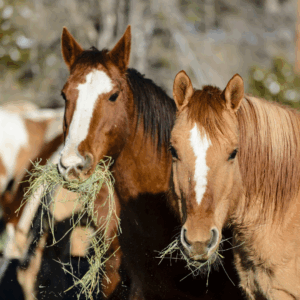
FoxFarm is passionate about producing the finest soil mixes, fertilizers, and micro-brewed liquid plant foods. Their formulas are greenhouse tested to ensure quality and consistency. Get 10% off this month.: two horses eating hay are picturedSeasonal Diet Changes for Horses: Pasture quality fluctuates with every season, but the shift in quality from summer to fall is significant.
During the fall, there are often warm, sunny days and cool nights. Pasture plants manufacture sugars in the presence of water, carbon dioxide and sunshine. They then use those sugars to fuel growth during the night. However, when nighttime temperatures drop in the autumn, it becomes too chilly for plants to grow and the sugars are stored for later use.  This leads to a concentration of stored sugars in the plants. In turn, it may increase the risk of digestive upset or laminitis in some horses.

Horses at most risk are those that are significantly overweight or those that have trouble managing normal blood sugar levels and are sensitive to sugar content in the diet.

Changing seasons also mean drastic swings in weather conditions and temperatures.  This, combined with a major diet adjustment of moving from pasture to hay, can increase the chance of digestive disturbances.

While not scientifically proven, many horse owners and veterinarians have experienced what appears to be an association between changes in barometric pressure and the incidence of colic episodes in horses. A dramatic drop in temperature often causes horses to drink less water. At the same time, horse owners will often increase the amount of hay fed to help horses stay warm.  More hay and less water consumption together may lead to impaction colic.

Hay:

As we move into fall and winter, hay becomes the major forage source for many horses.  Switching from pasture to hay or getting a new supply of hay represents as big a change to the horse as a change in grain. These significant dietary adjustments should ideally be made gradually to decrease the risk of digestive upset.

Horses should be fed good-quality hay to maximize nutrition and minimize potential digestive problems. Good-quality hay, of any variety, will be clean and have a high leaf-to-stem ratio, small-diameter stems. In addition, few seed heads or blooms, a fresh smell and appearance, and a bright color (faded, yellow or brown color may indicate aged hay or poor storage conditions). The maturity of the plant at harvest determines the hay quality more than any other factor. Young, leafy, immature plants contain more protein, energy, and minerals than older plants with thicker stems.  Also, as a plant matures, it contains more indigestible fiber (lignin). This reduces nutrient availability. Lower-quality hay must be supplemented with higher-quality feed to maintain horses’ good condition and health.

Fall is a season of transition and an important time to evaluate the quality of forage available for your horse and whether the grain ration is appropriate and adequate to meet your horse’s nutrient requirements. When winter arrives, horses must be in good condition to be able to withstand colder temperatures. Adjusting grain rations in the early fall will prevent weight loss due to lower-quality forage and, if horses need to gain weight, there is still time for a thinner horse to gain some before the cold weather really sets in.

For help dealing with Seasonal Diet Changes for Horses, visit Kissimmee Valley Feed!

Thanksgiving Safety Tips for Pets

Tuesday, November 8th, 2022

Thanksgiving Safety Tips for PetsKeep in mind these Thanksgiving safety tips for pets during the holidays. Let’s make sure it’s not a dangerous time for your furry friend! Enjoy time with your family and avoid a visit to your veterinarian by following this guide:

 Cut the fat:

Fatty or rich foods like beef fat, poultry skin, and gravy can cause severe gastrointestinal issues in pets, including:

  • Vomiting
  • Diarrhea
  • Excessive gas
  • Serious diseases like pancreatitis. Pancreatitis is a severe inflammation of the pancreas, an organ that produces digestive enzymes. On the mild side, pancreatitis can cause vomiting and a decrease in appetite, but can potentially be fatal.

If you want to treat your pet, it’s best to stick to a pet treat or a couple of small bites of lean poultry or unsalted/unbuttered vegetables.

Bones are bad:

Although bones from our holiday birds look good to pets, they are dangerous and can cause intestinal upset and may even splinter once digested.

Watch the packaging:

Make sure you dispose of any turkey or other food packaging quickly and appropriately.

All strings, plastic holders and bags that have a meat smell to them can be very attractive to a pet. Once ingested, these items can cause damage or blockage of the intestines.

Chocolate is particularly toxic:

Consider all the cookie and desserts offered during the holidays, many of which contain chocolate.

Chocolate is dangerous for dogs in particular because it contains theobromine, a caffeine-like ingredient that can be toxic to your pet. Dogs are not able to metabolize theobromine as quickly as humans. Complications include:

  • Digestive issues
  • Dehydration
  • Excitability
  • Slow heart rate

Later stages of theobromine poisoning include epileptic-like seizures and death. Keep your pet away from dark, semi-sweet and baker’s chocolate because they contain higher levels of theobromine.

We hope these Thanksgiving safety tips for pets were helpful! Check out Kissimmee Valley Feed’s Dog and Cat selection to treat them!

Source: Banfield

Navigation


Share this page

Calendar

July 2026
No event found!

Quick Info


Main Store
1501 Eastern Ave map

Saint Cloud, FL 34769..

Contact Info

Phone: 407-957-4100
Fax: 407-957-0450

Store Hours

Mon-Fri: 8:00 am - 6:00 pm
Sat: 8:00 am - 5:00 pm
Sunday Closed


Second Store
215 13th Street

St. Cloud, FL 34769

Contact Info

Phone: 407-892-4040

Store Hours

Mon-Fri: 8:00 am - 6:00 pm
Sat: 8:00 am - 5:00 pm
Sunday: Closed

Owner: Samantha Holloway
1501 Eastern AveSaint Cloud, FL 34769
Phone: 407-957-4100
Fax:407-957-0450

2nd Store
215 13th Street St. Cloud, FL 34769

Contact Info
Phone: 407-892-4040
Store Hours
Mon - Sat 9:00 am - 7:00 pm
Sun Closed