How Is It Different When Raising Chickens and Ducks Together?
Raising chickens and ducks together is a rewarding experience, but there are a few key differences to be aware of. One of the main differences is their growth rate. Ducks grow much faster than chicks, so you need a larger brooder to accommodate their size as they develop. Ducks also require more niacin, a nutrient essential for their rapid growth, which means you’ll need to ensure your feed contains enough niacin to support both species.
Another difference is their water habits. Ducks love water and will make a mess of their brooder by splashing and spilling, so you’ll need to clean and refresh their water more frequently to keep their living space dry and hygienic. Additionally, ducks are more likely to nest and lay eggs on the ground, while chickens prefer elevated nesting boxes.
Despite these differences, the basic needs for brooding–temperature, feed, and water–are similar enough that chickens and ducks can be raised together successfully from the start. Understanding and adjusting to their specific needs will help your mixed flock thrive.
What To Expect When Raising Baby Ducks and Chicks Together
Ducks and chickens can be kept in the same brooder and chicken coop. As mentioned above, expect your ducks to grow faster than your chicks. This is okay. They can still be kept together, but your ducks may be ready to move to the coop sooner than the chicks. The difference in growth may also require a larger brooder with more temperature zones–larger ducks can move to the cooler zones while smaller chicks can still get to the warmer zones. You will also need to be diligent in cleaning and refreshing the water in your brooder. Ducks LOVE water, and they spill and make a mess any chance they get!
What To Expect When Raising Adult Ducks and Chickens Together
Once the ducks and chickens are adults, they can absolutely be kept in the same coop, if that is what you want. Ducks and chickens can all free-range during the day and return to the same coop at night. Generally, ducks will stay together as one flock when exploring, while chickens are much more independent. They may venture out in small groups, but they usually explore individually. Your ducks will also nest and lay on the floor of your coop. Don’t be surprised if that also influences some of your hens to lie on the ground! It’s common to find brown or green chicken eggs in the same nest as white duck eggs. If you’re raising birds for egg production, provide a single high-quality complete layer feed for everyone. That makes feeding easy and keeps the egg quality great.
Feeding Chicken and Ducks Together
Baby ducks grow extremely fast and require 60 more kilocalories in each pound of feed than slower-growing baby chicks. Baby ducks do not convert their nutrients to niacin well, so they require extra niacin during rapid growth. With all these differences, how can a poultry owner balance the nutrient needs of their mixed flock while still keeping their feed manageable?
The magic lies within a really great flock feed. When we formulate mixed flock feeds, we focus on the essential nutrients for each poultry species we want to feed. Then, we balance those nutrients against the needs of the other birds. There is definitely some compromise, but in the end, we have a well-balanced feed that will work for many scenarios and different poultry types.
Chicken and duck mixed flocks are probably the most popular in many of our backyard flocks. As discussed in previous articles and above, baby ducks grow faster than baby chicks. They also have some unique nutritional requirements. Niacin is a B vitamin (B3), and most B vitamins are used to help convert food into energy.
Duckling Diets
Ducklings usually require about 20-60% more niacin than baby chicks, and that is because ducks grow extremely fast, and they are not very good at converting their other nutrients to niacin. Ducks deficient in niacin may develop leg deformities that can affect how they walk. Because of these unique requirements, you want to choose a high-quality flock feed that specifically mentions ducks as one of the species in the purpose statement or the feeding directions. This ensures that the unique nutrient requirements of ducks were considered when the feed was formulated. You can choose to feed Kalmbach 16% Flock Maintainer, which has a broader nutrient profile for all types of poultry. Or, if your ducks are layers, you can choose from any of our complete layer feed options.
Medicated Precautions
It is important to note that medicated chick feeds are NOT labeled for ducks. If you choose to raise baby ducks and baby chicks together, you should select a non-medicated feed. All feed companies are legally required to declare if a feed is medicated. The word MEDICATED will be noted on the label along with the type of medication, the purpose of the medication, and the inclusion of the medication. If nothing is written on the label to indicate that the feed is medicated, it is a non-medicated feed.
The great thing about Kalmbach 16% Flock Maintainer and another option, the Kalmbach 20% Flock Maker, is that these feeds contain LifeGuard® Poultry, an all-natural blend of ingredients that naturally supports gut health and immunity. These feeds are a great way to help protect and boost your birds’ immune systems without using medications. On a side note, most medications (amprolium) used in chick feeds are very safe. So, if your ducks have accidentally consumed medicated chick feed, it is unlikely to harm them.
Can I Add Turkeys or Gamebirds to My Mixed Flock?
Before we dive into nutrient needs, I encourage anyone who wants to have turkeys in a mixed flock to do your research on Blackhead Disease.
Turkeys and gamebirds have very high nutrient requirements when they are babies. Turkey poults require 40% more protein than chicks intended to become layers. They also need a lot of energy to support their rapid growth. Unless you are raising slow-growing heritage varieties, the gap between turkeys/gamebirds and chicks’ nutrient requirements is too wide for a good compromise. This is why starting turkeys and gamebirds on a feed specifically formulated for those species is probably best for those birds. You may have to feed turkeys and gamebirds separately from other poultry species for the first 3-6 weeks of life to give them the best start.
Nutrient Needs
Most of the differences mentioned in this article result from rapid growth that occurs in the first few weeks of a bird’s life. Each species grows differently and has different nutrient needs during those times. Do you remember how much your kids ate during a growth spurt? Poultry do the same thing! Chickens and ducks included. However, once those birds reach adulthood, most species actually have quite similar nutrient requirements. For example, an adult laying duck has nutrient requirements similar to a laying hen’s. This is why most adult laying ducks do very well on complete layer diets.
Adult non-producing poultry – turkeys, roosters, gamebirds, retired hens – are all in a nutrient state called maintenance. These birds still need good, balanced nutrition, but their bodies are no longer in rapid growth or production. Maintenance requirements are usually much lower than those of birds in the growth or production stage. A high-quality maintenance feed like Kalmbach 16% Flock Maintainer is the perfect option for mixed flocks. This feed still provides solid, quality nutrition to help your birds stay healthy, strong, and beautiful without excessive nutrient waste.
Keeping mixed flocks is fun! There is something so charming about seeing a nice blend of poultry out, pecking around, and enjoying a peaceful afternoon. We encourage all our poultry lovers to keep expanding their flocks, learning about different types of poultry, and having fun! We are here to help you on every step of your poultry journey!





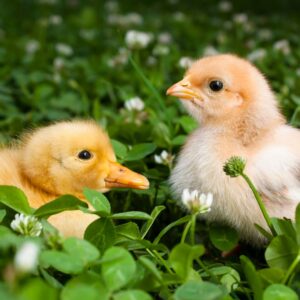 Mixed Flock Guide: Can Chickens and Ducks Live Together? Have you ever been tempted at the farm store, looking for chicks, only to see adorable ducklings and wonder, “Can I raise chickens and ducks together?” The answer is a resounding YES! Ducks and chickens can coexist harmoniously, if their basic needs are met with the right
  Vaccinate Your Cattle This January: As we start a new year, it’s important for cattle farmers to start thinking about vaccinating their herds. Vaccinating your cattle is one of the most important things you can do to protect their health, and ultimately, your livelihood. Let’s explore why January is a good time to start thinking about vaccinating your cattle, what vaccines are available, and how to determine which vaccines are right for your herd.