

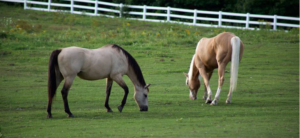
 Springtime Weight Gain in Horses: Winter can be hard on horses. When spring arrives, it is not unusual to find that a horse has dropped weight during the coldest months. When the mercury drops, a horse requires more energy to maintain body temperature. Winter is especially challenging for senior horses and young horses, who have a harder time maintaining body temperature. A sound nutrition program and suitable exercise can help remedy loss of condition as winter turns to spring.
Cold increases energy needs:
Horses have an estimated lower critical temperature (LCT) between 30-50○ F (-17-10○ C), depending on general body condition and thickness of haircoat. If the temperature falls below the LCT, a horse needs to burn energy to keep warm. For every 10○ F (5.5○ C) the temperature drops below LCT, a horse needs an estimated additional 2,000 kilocalories (kcal) to maintain body temperature. Often, this can be achieved with an extra 3 lb (1.4 kg) of hay.
“Hay is the best option for helping a horse create its own warmth,” said Kathleen Crandell, Ph.D., a nutritionist for Kentucky Equine Research. “Hay is fermented in a part of the hindgut called the cecum. Because internal heat is a byproduct of fermentation, consuming and processing hay keeps a horse warm.”
However, when rain and wind become factors, increases in energy needs can quickly escalate beyond what can be satisfied by hay alone, Crandell explained. In this case, concentrates and fat supplements are valuable in supplying calories. In regard to fat supplements, for example, one-half cup (4 oz or 120 ml) of vegetable oil provides approximately 2,000 kcal.
Body condition as a tool for weight management:
Assessing body condition year-round is the best management tool to identify changes in weight. The most familiar body condition scoring system features a scale from 1 to 9 that gauges fat cover and distribution. A score of 1 or 2 denotes an emaciated horse (veterinary intervention may be necessary), 3 or 4 is thin, 5 or 6 is ideal, and 7, 8, or 9 is overweight or obese.
Keeping track of weight, as well as body condition, is also important. A weight tape, placed around the horse’s barrel, directly behind the shoulders as the horse stands square, is an excellent tool for estimating weight and monitoring change. Measuring is important, as horse owners often notice changes in a measurement before noticing weight fluctuations visually. Weigh at a regular time every four to six weeks. For example, the first day of every month or each time the horse is visited by the farrier. Keep a log to track weight, pinpoint fluctuations, and adjust the diet accordingly.
If a horse is thin after winter, it is important to ask why. Is it related to a health problem (teeth, soundness, pain)? Is the horse stressed in some way (evolving herd dynamics, limited feeding stations)? Have your veterinarian conduct a wellness exam at least once per year. Take stock of the horse’s environment and behavior. What changed, if anything?
Concocting diets for weight gain:
Simply put, to gain weight a horse needs to consume more calories than it burns. Weight gain should be slow and controlled. Avoid rapid weight gain. Forage alone may not have enough calories for significant weight gain. Concentrates and fat supplements can help in these situations. To achieve an increase of one body condition score (e.g., from a 3 to 4), the average 1,100-lb (500-kg) adult horse needs to gain 44-50 lb (20-23 kg). That gain can take 30-60 days. Be patient. The amount of increased feed in the diet will depend on the individual horse, overall health, and activity level. Slowly make changes and increases in feed intake. Offering several small meals of grain is preferable to one or two larger meals.
Do not underestimate the caloric value of pasture. “Horses on pasture may benefit from the increase in calories with the improved quality of the spring grasses,” noted Crandell. “Fresh spring grass is high in digestible fiber, from which the horse can derive lots of energy.”
Forage should make up no less than 50% of the horse’s diet and ideally more (70-100%, depending on the horse’s needs). For horses with dental concerns that may not be able to chew hay properly, forage substitutes like soaked hay cubes, chopped forage, and soaked beet pulp often work well.
A high-fat, low-carbohydrate diet is recommended for horses with metabolic concerns. For example, horses with Cushing’s syndrome or metabolic syndrome, that also need to gain weight. Limit pasture grazing with a grazing muzzle or drylot turnout. Hay can be soaked to reduce dietary carbohydrates as well. “A combination of soaked hay, a high-fat, low-carbohydrate concentrate, and a fat supplement, if added calories are needed, often suits these horses well,” Crandell recommended.
Resources:
Article Sources: Kentucky Equine Research
 Preparing Your Animals for Breeding Season: Breeding season is a crucial time for animal owners, full of possibilities and excitement. However, it can also be a challenging period, especially if you are new to the process. Getting your animals ready for breeding takes careful planning and consideration. Ensuring your animals are healthy and in top condition is vital to a successful breeding season. Whether you’re a seasoned breeder or a newcomer, we have put together a guide to help you prepare for the breeding season ahead. We also carry
  Spring and Summer Horse Health Tips: Our experts have gotten together to provide some information and tips on how to keep your horse healthy and comfortable in the ever-changing seasons. When spring and summer arrive, so do hot temperatures! You can’t forget the new plants, allergies, insects, and pests.