Archive for June, 2024

How to Keep Horses Cool in Hot Weather

Tuesday, June 18th, 2024

How to Keep Horses Cool in Hot WeatherHow to keep horses cool in hot weather? As summer drags on, heat can become a serious problem for many horses.

Sweating is the primary way horses cool themselves. Experts believe that prolonged, consistently high sweat rates can lead to “exhaustion” of the sweat glands. In horses, this may result in anhidrosis, or the inability to produce sweat adequately. It is crucial to address anhidrosis and find other ways to keep horses cool because it can pose a serious health risk to horses in warm climates.

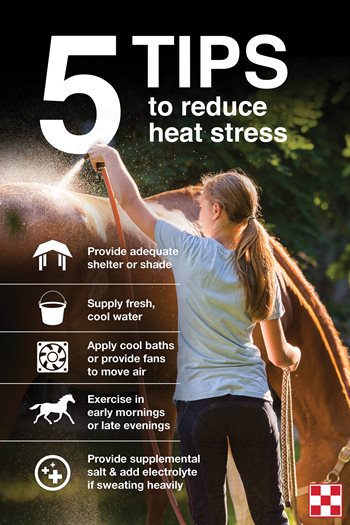
Here are a few tips to keep in mind when trying to keep your horses cool this summer.

1. Fresh, cool water

Hydration is critical during hot weather, but poor water quality can severely limit your horse’s intake. Most horses don’t like to drink hot water, so it is best to provide fresh, cool water daily. Dark-colored troughs or buckets placed in direct sunlight will absorb heat and warm the water quickly.

Keep horse water troughs and buckets clean and free of algae to encourage drinking. Remember, it can be hard to see accumulated algae and debris at the bottom of a dark-colored trough. Another tip: overfill water buckets and troughs to provide moisture for your horse’s hooves, especially in dry climates.

2. Salt and electrolyte supplementation

Feeds do not contain enough salt to meet a horse’s daily sodium requirement. Therefore, an additional source of salt is always recommended. At a minimum, a salt block should be available free choice. However, horses are not natural lickers and may not lick enough voluntarily. Top-dressing their feed with 2 oz plain salt per day is a good way to ensure they get enough.

In the “sweating season,” whether due to temperature or workload, salt should be switched to a quality electrolyte. This will supply important minerals like potassium and calcium, in addition to salt, that your horse loses through sweat. The best electrolytes will be mostly minerals, not sugar.

3. Summer horse shelter

We can all appreciate how much cooler it is under the shade tree in the middle of summer versus being out in the full sun, and your horse feels the same way. If there are no trees in your turnout areas, providing a run-in shed or even a fabric sunscreen as a horse shelter can make a big difference in helping to keep your horses cool.

Horses cool themselves primarily through evaporative and convective cooling. To help them, apply cool baths or use sprinklers to keep your horses more comfortable and to decrease their need to sweat as much. Moving air increases both convective and evaporative cooling. If the breeze isn’t blowing, provide a fan to move the air. Some farms even use large golf course fans to keep their horses cool in pastures. Finally, remember it may be more comfortable outside in the sun than inside a stuffy barn with poor airflow.

4. Exercise and heat stress in horses

Metabolic heat from exercise is another primary heat source for horses; therefore, it is best to confine strenuous exercise to early morning or later evening hours when ambient temperature and humidity are the lowest. Alternatively, you can give yourself and your horse a break from hard training during the hottest summer months.

To avoid additional heat stress, postpone events such as vaccination, weaning, changing barns, moving horses between groups, etc. If any of these events must occur during the hottest days of summer, try to do them during the coolest hours of the day.

Even though summer can be a sweaty, uncomfortable time, these tips can help your horse stay healthy and happy year-round.

Check out Kissimmee Valley Feed’s equine feed & supplements to help your horse stay happy!

Article source: Purina Animal Nutrition
Signs That Your Horse Has An Insect Problem

Saturday, June 1st, 2024

How to Tell if Your Horse Has an Insect ProblemSigns That Your Horse Has An Insect Problem: We’ve all had times where we wish our horses could talk and tell us what’s bothering them. The truth is, horses do communicate as best they can. It’s up to horse owners to pay attention to behaviors and physical signs to interpret what’s wrong. (And don’t forget to visit KVF for your horse supplies!)

You know fly season is in full swing when horses are reacting to flying pests. Stomping feet, swishing tails and shaking heads are all normal behavioral responses to flies and insects. Is there a pond or mud puddle available? Horses will often roll or stand in it in an effort to avoid flies.

But some horses also exhibit physical signs that insects are bothering them more than normal.

  • Is your horse’s hair falling out in clumps?
  • Does his mane have places where he’s rubbed out some or even all of the hair?
  • Does he vigorously scratch his tail on fence posts, stall walls or trees?
  • Are there places where his skin is irritated or even raw?

These are obvious signs your horse is having trouble with insects that shouldn’t be ignored.

When your horse acts “itchy”

It’s not unusual for a horse to use stationary objects, like a fence post, to scratch an occasional itch. But when a horse walks away from food to scratch or repeatedly rubs his ears, tail, mane, neck or belly to the point that his hair is falling out and his skin is raw–or even bleeding–there is a definite reason.

How can you know if your horse is actually allergic to insect bites, or if he just has irritated skin from being bitten?

“A horse with substantial hair loss or incessant itching likely needs to see a veterinarian who can do some diagnostic testing to nail down a cause,” notes Martha Mallicote, DVM, Dipl. ACVIM, veterinarian and large animal clinical assistant professor at the University of Florida.

“With skin disease, it’s very temping to label it as ‘not that important’ and just treat with over-the-counter ‘remedies.’ But the reality is that some horses with significant allergies need really aggressive therapy to improve their actual quality of life–not just the quality of their hair coat,” adds Mallicote.

She explains that there is not a definitive way to differentiate “itchy” from an actual sensitivity other than allergy testing, which would show any allergens that are affecting the horse. In such cases, your veterinarian’s expertise can get to the root of the problem and help your horse be more comfortable.

“A vet will complete a physical exam, including close inspection of the abnormal skin, and likely choose to take skin samples for culture, cytology or other testing,” says Mallicote.

Signs of insect allergies

Unfortunately, in addition to the aggravation factor, some horses are actually allergic to insect bites. Signs of substantial insect allergies include:

  • frequent itching to the point of destruction of fences and stall equipment from the horse’s rubbing
  • welts or swelling in the affected area
  • hair loss from intense rubbing due to itching
  • broken skin, sometimes to the point of bleeding

If your horse has intense itching and hair loss in specific areas, this can indicate an allergic reaction to specific pests known as culicoides.

“The classic distribution of hair loss for a culicoides-sensitive horse is the mane/neck, tail head and ventrum (belly) of the horse,” explains Mallicote.

Culicoides sensitivity

Tiny biting midges, sometimes described as “no-see-ums,” but properly identified as culicoides, can cause extreme distress by biting the horse’s mane, tail and belly, especially if the horse is allergic to the insect saliva. Affected horses will scratch themselves on almost any stationary object in an attempt to relieve the extreme itching.

Culicoides sensitivity may also be referred to as “sweet itch.” In addition to severe itching, it’s common for horses with this condition to have patches of skin with broken or missing hair, scaliness and even oozing lesions. Secondary infections are possible when the skin is broken.

“Culicoides sensitivity is quite common, especially in the Southeastern U.S., but most horses have a more manageable case of the disease,” says Mallicote. “There are certainly those horses that are especially sensitive and do develop those really severe signs that indicate they are so terribly itchy that they cannot stop scratching.”

For those horses, Mallicote says it’s important to minimize exposure to culicoides. These biting midges are most active around dusk, so protecting horses that are sensitive typically means stabling them at this time of day and using fans that create a strong enough air current to keep midges from landing on the horse and biting.

Veterinarians treating such horses may have to prescribe strong anti-inflammatory medication to help get the itch under control.

Be proactive

If your horse has had issues in the past and reacted to insect bites by rubbing his mane and tail until his hair is falling out, you’ll want to take proactive steps before he’s under assault again.

“Get started with fly spray early in the season. Apply an effective product at least once daily and make sure to use enough product to really cover the horse,” advises Mallicote.

Farnam’s Endure Sweat-Resistant Fly Spray for Horses is an effective choice for hard-working horses that will be sweating, while Nature’s Defense Water-Based Fly Repellent Spray is a non-chemical, botanical-based option that also offers great protection.

Read all the directions on the spray bottle to be certain you are applying the correct amount. Use the product as recommended. Many horse owners inadvertently don’t apply enough insect repellent to perform as the product label promotes.

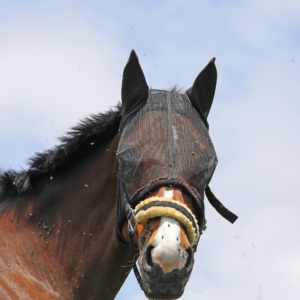
Physical barriers–such as Farnam’s SuperMask II Horse Fly Mask, boots and sheets–may be needed for those horses that are overly sensitive to insects. For pastured horses, spot-on repellent products may also be beneficial.

“As for some situations, long-acting products are also helpful. Not in place of the fly spray but in addition to it,” adds Mallicote. “For sensitive horses, start using fly sheets and fly masks before they are needed to minimize exposure.”

Mallicote reminds owners that these horses will benefit from being stalled with a strong fan. Especially during the time of day when pests are most active.

Keep an eye on your horse’s behavior and watch for physical signs that indicate insect irritation or possible allergy. This way, your horse won’t have to “shout” to get your attention if he’s suffering from pests.

Farnam, Cynthia McFarland


Navigation


Share this page

Calendar

No event found!

Quick Info


Main Store
1501 Eastern Ave map

Saint Cloud, FL 34769..

Contact Info

Phone: 407-957-4100
Fax: 407-957-0450

Store Hours

Mon-Fri: 8:00 am - 6:00 pm
Sat: 8:00 am - 5:00 pm
Sunday Closed


Second Store
215 13th Street

St. Cloud, FL 34769

Contact Info

Phone: 407-892-4040

Store Hours

Mon-Fri: 8:00 am - 6:00 pm
Sat: 8:00 am - 5:00 pm
Sunday: Closed

Owner: Samantha Holloway
1501 Eastern AveSaint Cloud, FL 34769
Phone: 407-957-4100
Fax:407-957-0450

2nd Store
215 13th Street St. Cloud, FL 34769

Contact Info
Phone: 407-892-4040
Store Hours
Mon - Sat 9:00 am - 7:00 pm
Sun Closed